
Free written scope consultation - allowances, timeline, and change-order rules on paper before a single trade is scheduled
Styles & brands we work with
- Kitchen remodeling
- Bathroom remodeling
- Home additions & ADU
- Roofing
- Windows & doors
- Driveway & pavers
- Fence
See the difference
 Before
 After
 Before
 After
 Before
 After
How Thick Should a Concrete Driveway Be in Fort Worth, TX?
For most Fort Worth homes, a concrete driveway should be at least 5 inches thick with #3 rebar on an 18-inch grid, or 4 inches thick if it’s fiber-reinforced with control joints cut every 8 to 10 feet. The national 4-inch rule was engineered around frost depth, and Fort Worth’s frost line sits under 6 inches, so freeze-thaw isn’t your enemy here. Expansive black clay is. Get the thickness and the reinforcement spec wrong together and you’re pouring a driveway that cracks within a couple of years.
If you’d rather not guess at the spec, call Groundwork Construction Co. of Fort Worth at (855) 912-5373. We answer live, 24/7, and we’ll walk you through exactly what your slab needs.
Why the 4-Inch Rule Doesn’t Translate to Fort Worth
Most thickness charts you’ll find online were written for cold-climate markets. They assume a slab needs enough depth to sit below the frost line so freezing ground doesn’t lift and crack it. That logic works in Minnesota. It doesn’t apply in Fort Worth, where the frost line rarely gets past a few inches and the ground almost never freezes deep enough to matter.
What does matter is the soil. North Texas sits on expansive black clay that swells when it’s wet and shrinks hard in summer drought. That movement pushes sideways against a slab and heaves it vertically. A driveway here isn’t fighting ice; it’s fighting soil pressure. Thickness alone doesn’t win that fight. Reinforcement does.
This is the piece most homeowners never hear: a thicker slab with no steel is still a slab that will crack. Thickness buys you load capacity. Rebar or fiber buys you crack control. Decide them separately and you’ve wasted money on one of them.
Our technicians have up to 12 years of experience pouring and finishing slabs across Fort Worth’s soil conditions. That’s the kind of job knowledge that changes a spec sheet.
What Spec Should You Actually Ask For?
There are two honest choices for a Fort Worth residential driveway, and both work if they’re built right. Here’s how they compare.
| Spec | Thickness | Reinforcement | Control Joints | Best For |
|---|---|---|---|---|
| Standard | 5 in. | #3 rebar, 18-in. grid | Cut to 1.25 in. deep, every 8-10 ft. | Most Fort Worth homes, heavier vehicles, long driveways |
| Value | 4 in. | Fiber mesh | Cut to 1 in. deep, every 8-10 ft. | Light-duty driveways, tighter budgets, pedestrian-heavy use |
Here’s where the trade-off lives. The 4-inch fiber option costs less because it uses less concrete and no steel grid. It performs fine for a single passenger car in a driveway that won’t see a loaded work truck. The 5-inch rebar option costs more upfront but handles Fort Worth clay movement and heavier loads with far more margin.
If you’re comparing bids, ask each contractor which spec their number includes. A low bid almost always means 4-inch unreinforced or fiber only. That’s not a scam; it’s just a different slab than the one you thought you were buying.
Control Joints: The Spec Most Homeowners Have Never Heard
Concrete cracks. You can’t stop it, but you can decide where it cracks. That’s what control joints are for, and the depth and spacing are set by the slab thickness.
The rule: cut joints to a quarter of the slab depth. On a 5-inch slab, that’s 1.25 inches deep. On 4 inches, it’s 1 inch. Space them no more than 10 feet apart, and tighter in narrower slabs. Cut too shallow and the crack wanders instead of following the joint. Space them too wide and you get random fractures running across the driveway instead of clean lines.
Fort Worth’s summer heat makes this timing-sensitive. Joints need cutting while the concrete is still green, usually within 6 to 12 hours of finishing, before it shrinks and sets. On a 100-degree July pour, that window is shorter than it is in cooler months. Ask us or any contractor how soon after the pour they’ll be back to cut joints. If they can’t answer, that tells you something.
You can see the full range of finishes and options on our Driveway & Pavers in Fort Worth page.
The Multiplier Nobody Talks About: Sub-Base and Compaction
A 5-inch slab over loose, poorly compacted clay will fail faster than a 4-inch slab over a properly prepped base. This is the part of the spec that gets skipped in every thickness guide, and it’s the difference between a driveway that lasts 25 years and one that’s cracking by year three.
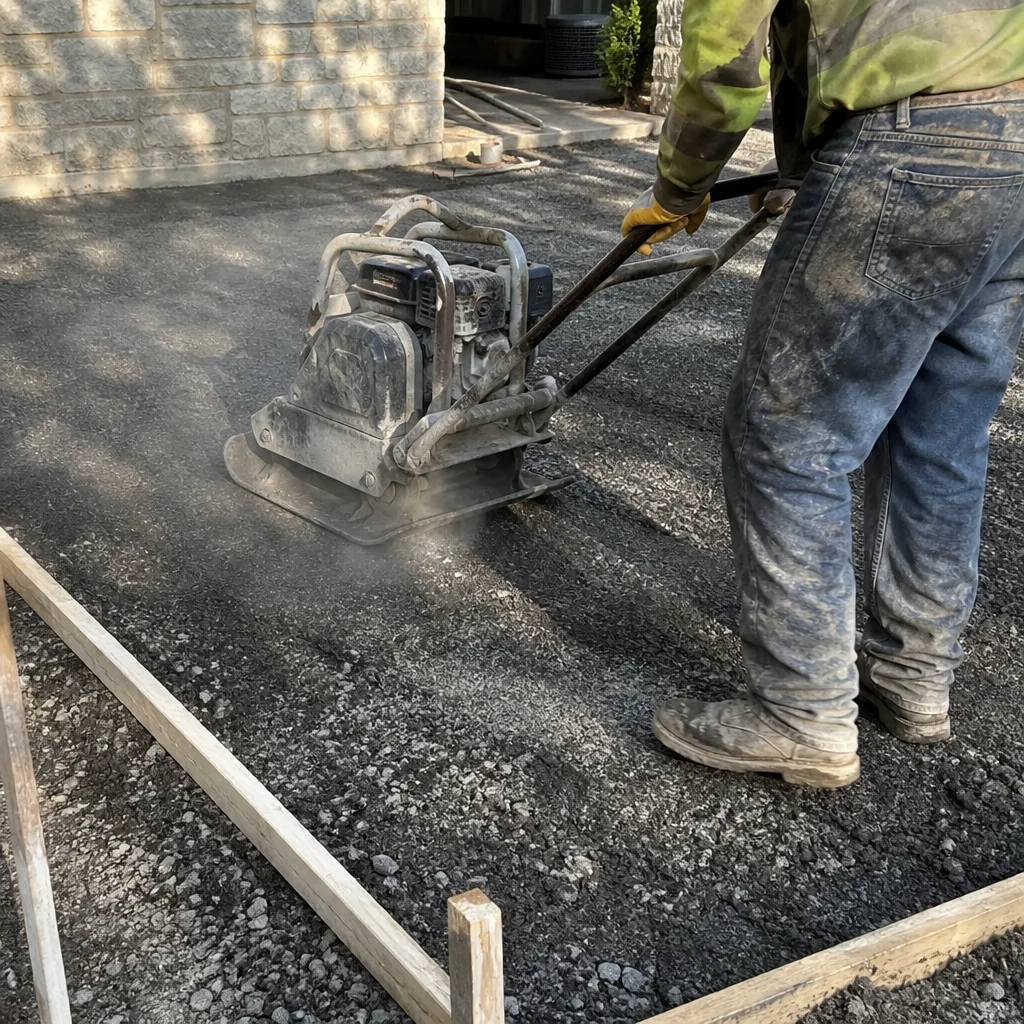
For Fort Worth clay, the right prep usually means 4 to 6 inches of compacted crushed base, sometimes lime-stabilized for problem soils. That base has to be compacted in lifts, not dumped and raked. It has to be graded so water sheds away from the slab and the house, not pooling under it.
Ask what depth of base the bid includes and whether the soil will be stabilized. A contractor who can answer that in specific inches and materials is a contractor who understands Fort Worth ground. One who hand-waves “we’ll prep it right” doesn’t.
Need a comparison to paver options? Our Driveway & Pavers service page lays out both paths.
What Drives the Cost in Fort Worth
Concrete driveway installation in Fort Worth runs $4,500 to $12,000, and the spread isn’t arbitrary. Thickness, reinforcement, sub-base prep, square footage, and access all move the number.
- Standard 5-inch slab with rebar: priced at the higher end of the $4,500-$12,000 range, but the slab is built for Fort Worth clay movement.
- 4-inch fiber-reinforced slab: typically the entry point, with a shorter service life for heavy loads.
- Driveway replacement: $5,000-$14,000, including tear-out and haul-off of the old slab.
- Driveway sealing: $250-$700, worth budgeting every few years to slow moisture cycling.
We publish the slab thickness and reinforcement spec as explicit line items on every quote, so you can see exactly what you’re paying for. Upfront pricing, no surprises. And projects over $10,000 get $1,000 off, with 0% financing for 18 months available.
How Does Fort Worth’s Building Stock Shape the Job?
Fort Worth builds at two speeds. In Fairmount and Ryan Place, crews pour driveway replacements beside early-1900s homes where the old approach may sit against pier-and-beam foundations and true-dimension lumber. Out past Loop 820 toward Alliance and Walsh Ranch, fresh tract and custom builds get brand-new slabs on freshly graded lots that still need time to settle.
Those two jobs ask for different thickness calls. A replacement in an established neighborhood has to match existing elevation at the apron, which sometimes forces a thinner slab. A new build has room to pour at full depth and design the grade from scratch. Neither problem shows up on a generic thickness chart.
Whatever the site, our work is covered by the 730-Day Done Right Promise. If it’s not done right, we make it right. From foundation to finish line, one contractor is on the hook for the whole job.
FAQs
Four inches is the minimum, and it only holds up if it’s fiber-reinforced with properly cut control joints every 8 to 10 feet. On Fort Worth’s expansive black clay, 5 inches with rebar on 18-inch centers gives you much more margin. If you park anything heavier than a passenger car, go with 5 inches.
Call (855) 912-5373 and we’ll tell you which spec fits your driveway, free of charge.
Concrete driveway installation in Fort Worth typically runs $4,500 to $12,000, depending on thickness, reinforcement, and square footage. A replacement including tear-out runs $5,000 to $14,000. The difference between a low bid and a mid bid is almost always the slab spec and base prep.
Call (855) 912-5373 for an exact quote. Estimates are free, and we itemize the spec.
Rebar is the stronger choice for Fort Worth’s clay soils. Fiber mesh controls surface cracking and works for lighter-duty driveways, but it doesn’t resist lateral soil pressure the way an 18-inch rebar grid does. If your soil is noticeably expansive or your driveway is long, rebar is worth the added cost.
Not sure which your lot needs? Call (855) 912-5373 and we’ll assess it.
Plan on keeping vehicles off a new driveway for at least 7 days, and longer in cool weather. Foot traffic can usually resume after 24 to 48 hours. Control joints need to be cut within 6 to 12 hours of finishing, well before that point.
We’ll give you the exact cure timeline in writing with your estimate. Call (855) 912-5373 to schedule.
Get the Spec Right the First Time
Thickness without reinforcement is a timer, and in Fort Worth it runs down fast on clay soil. If you’d rather have it looked at, Groundwork Construction Co. of Fort Worth offers a no-pressure assessment in Fort Worth. We’ll check your soil, your grade, and your use case, then put the thickness and rebar spec in writing. Call (855) 912-5373 for a free estimate.
Written by the team at Groundwork Construction Co. of Fort Worth, serving Fort Worth, TX.


