Last updated November 18, 2026


Free written scope consultation - allowances, timeline, and change-order rules on paper before a single trade is scheduled
How Long Does Driveway & Pavers Take? Timelines and What to Expect
A contractor who says your driveway takes “3 days” isn’t lying. They’re quoting you the paver-laying phase while glossing over the week-plus of excavation, compaction, and curing that surrounds it. That gap between the sales number and the real calendar is where most homeowner frustration starts. We’re writing this guide to close that gap: the full sequence from first shovel to final seal, realistic day counts for each phase, how Fort Worth heat and clay soil shift the schedule, and what actually goes wrong on Texas jobs. By the end you’ll know how to read a paver bid for what it really costs you in time.
Quick Answer
A standard two-car paver driveway in Fort Worth takes 5 to 10 working days from demolition to final joint sand, plus a 1 to 3 week material ordering window before work begins and a 24 to 48 hour cure before the sealant goes down. Small single-car driveways can finish in 3 to 5 days. Long driveways, tight access, or a base repair after excavation can stretch to 2 to 3 weeks. Most of the schedule is preparation, not laying pavers.
Styles & brands we work with
- Kitchen remodeling
- Bathroom remodeling
- Home additions & ADU
- Roofing
- Windows & doors
- Driveway & pavers
- Fence
Table of Contents
- The Full Timeline: Every Phase From Demo to Seal
- How Fort Worth Heat and Clay Soil Change the Schedule
- What a Realistic Fort Worth Two-Car Driveway Schedule Looks Like
- What Commonly Extends a Paver Timeline
- The Difference Between a Rush Job and a Right Job
- Permits, Inspections, and Intake Timing
- Common Mistakes to Avoid
- When to Call a Professional
The Full Timeline: Every Phase From Demo to Seal
Here’s the honest sequence a paver driveway follows. Each phase matters. Skip one and the pavers will fail within a few seasons regardless of how good the surface looks on day 1. This is the sequence the team at Groundwork Construction Co. of Fort Worth home follows on every job, and the sequence any reputable Fort Worth paver installer should be able to break down day-by-day on paper before you sign.
- Demo and haul-off – 1 to 2 days. Old concrete, asphalt, or gravel gets broken up with a skid-steer or mini-ex and hauled to a certified disposal site. Concrete is heavy: a 400 square-foot drive yields 8 to 12 tons of debris, which means 2 to 3 dumpster loads.
- Base excavation – 1 to 3 days. The subbase gets excavated to a depth of 6 to 9 inches (deeper for pavers rated to heavy loads). This is where buried surprises come up: old footing remnants, tree roots, utility stubs, and in older Fort Worth neighborhoods, the ghost of a pre-war gravel drive.
- Compaction of the subgrade – half a day. A plate compactor or vibratory roller runs over the exposed native soil in 2-inch lifts. This step alone catches many rushed installers who skip the lift-by-lift approach.
- Gravel base installation and compaction – 1 to 2 days. 4 to 6 inches of crushed stone (typically #57 or road base) goes down in 2 to 3-inch lifts, each compacted to 95% density with a plate compactor. Rush this and you’ll be re-leveling pavers within 18 months.
- Edge restraint – half a day. Aluminum or plastic edging is anchored with 10 to 12-inch spikes around the perimeter. The restraint is what stops the pavers from spreading under load.
- Sand bed and screeding – 1 day. A 1-inch bedding sand layer gets screeded flat, and no one walks on it before the pavers go down. That’s why screeding and paver-laying typically happen back-to-back on the same day.
- Paver laying – 1 to 3 days. This is the “3-day” number most contractors quote. A crew of 3 lays roughly 400 to 600 square feet per day. A 500 square-foot two-car drive takes 1 full day of laying plus a half-day of cutting around edges and fixtures.
- Cutting and edge pavers – half a day. Wet saw work for the perimeter, which requires patience with Fort Worth’s variable limestone and sandstone colors to keep the coursing visually consistent.
- Joint sand – half a day. Polymeric sand gets swept into the joints, activated with water, and left to set. On a hot Fort Worth summer day, the joint sand might need a second application after the first settles.
- Final compaction – half a day. One last plate-compactor pass on top of the pavers drives the joint sand into the gaps and seats everything into the base.
- Sealing – 1 day, scheduled 24 to 48 hours after install. Some homeowners wait 30 to 90 days before sealing to let efflorescence burn off. Either way, sealant is not part of the install day count. It’s an appointment.
Add the phases up and a Fort Worth two-car driveway lands in the 6 to 9 working day range for install alone, plus the material lead time before a shovel hits dirt.
How Fort Worth Heat and Clay Soil Change the Schedule
Fort Worth is not a neutral climate for paver work. Two things in particular move the timeline: our summer heat and our expansive clay soil. Both are manageable, but only if the schedule was planned around them from day 1.
Summer heat and cure times
From late June through early September, afternoon temps in Fort Worth regularly hit 102 to 106°F. Concrete doesn’t like to cure in that. If you’re replacing an old concrete apron, pour crews work early mornings and after sunset to keep the mix from setting up too fast. For pavers, the tight spot is the polymeric sand joint activation: water evaporates before it can fully activate, and the sand surface skins over and scrubs out on the first rain. On 95°F days our crew schedules joint sand work for 7 to 10 a.m. and returns the next morning to check the surface.
Clay soil and base prep
The blackland clay running through much of Fort Worth swells when wet and shrinks when dry. That soil movement is what cracks concrete slabs and heaves paver surfaces that weren’t properly based. Expect extra excavation on clay-heavy lots in neighborhoods like Ridglea Hills, Wedgwood, and the older sections of Arlington Heights: what the bid lists as 6 inches of base sometimes has to become 8 or 9 to stabilize the subgrade. That’s a real schedule hit and a real cost item, and a builder who won’t flag it during the estimate is one to walk away from. Our background-checked, uniformed technicians photograph base depth at every lift so the homeowner has proof the schedule wasn’t cut short.
Rain and drainage
Fort Worth averages around 34 inches of rain per year, with spring storm cells that dump 1 to 2 inches in an hour. Paver installs pause on those days because the sand bedding cannot survive standing water. Schedule a rain allowance of 1 to 2 days for any Fort Worth work planned between March and May.
What a Realistic Fort Worth Two-Car Driveway Schedule Looks Like
Here’s the schedule we’d quote for a typical 500 square-foot, two-car paver driveway in Fort Worth, assuming a signed contract in mid-May, a standard 4 to 6-inch base, and reasonable weather. Use this as a template to compare against any other bid you receive.
- Week 0 (contract signing): Material order placed. Paver lead time is 1 to 3 weeks depending on the brand and color selection. This is where most DIY-timeline projections go wrong; the pavement doesn’t start when you sign, it starts when the pallets arrive.
- Day 1: Permits confirmed (if required by the city of Fort Worth, usually only when the drive is being widened or a new apron is cut into the curb). Demo begins mid-morning after debris containers land.
- Day 2: Demo finish and haul-off. Excavation starts in the afternoon.
- Day 3 to 4: Base excavation and subgrade compaction. Photographed and documented at each lift.
- Day 5 to 6: Gravel base installation and compaction. Edge restraint set. Screeding if the base has settled overnight.
- Day 7: Sand bedding and paver laying.
- Day 8: Cutting, edge pavers, and perimeter cleanup.
- Day 9: Joint sand activation and final compaction.
- Day 10: Site walkthrough, cleanup, and homeowner orientation (protectant seal timing, sweeping schedule, first freeze warning).
- Week 3 to 4 (scheduled post-install): Sealer application, if the homeowner chooses it, on a dry 60 to 80°F day.
Add 1 rain day and you’re at 10 to 11 working days on the calendar. Add a buried utility line and you’re at 2 weeks. That’s a realistic Fort Worth paver schedule. Any quote that says “3 days” or “5 days” is quoting a phase, not a project.
For a deeper walkthrough of the paver options we install in Fort Worth, see our Driveway & Pavers in Fort Worth page.
What Commonly Extends a Paver Timeline
We’ve watched these five things extend Fort Worth paver timelines more than anything else. They’re all manageable if you know to plan around them.
- Material lead times. Standard gray pavers can ship in 5 to 7 days. Premium color blends, tumbled finishes, and larger format pavers from brands like Belgard often run 2 to 4 weeks, and specialty color blends can push to 6. Order early or put a deposit on pavers that are already in stock at the supplier.
- Permit delays. Most Fort Worth driveway replacements on an existing footprint don’t require a permit. A driveway widening, a new curb cut, or a change to a commercial apron does, and the city approval runs 3 to 6 weeks. If you’re adding a bay for a third vehicle, schedule the permit application before you order anything else.
- Weather holds. Rain in spring and early summer, hard freezes in January and February (Fort Worth saw a week-long freeze in 2021 and brief hard freezes in 2022 and 2023), and, occasionally, extreme heat days in July or August. Build 2 to 4 days of weather buffer into any Fort Worth schedule between March and October.
- Subbase surprises. Buried debris, an old septic tank lid, a mound of formerly-buried concrete, tree roots from a live oak 20 feet away. Each one adds 1 to 3 days of removal and re-compaction before the base can continue.
- Utility conflicts. Sprinkler lines, gas stubs, and cable runs that weren’t marked before excavation add a day. Always call 811 (Texas Utility Locate) before any dig; the wait for locates is 2 to 3 business days.
Honest ranges from a Fort Worth contractor with real numbers attached look like this: 3 to 5 days for a single-car drive; 6 to 12 days for a two-car drive; 2 to 3 weeks for three-car drives, circular drives, or installs over poorly-drained clay. Any three-day promise on a two-car drive is a red flag.
The Difference Between a Rush Job and a Right Job
Schedule pressure is the single biggest cause of paver driveway failures in our region. When a homeowner pushes for a faster finish, or when an installer overbooks, the first things to go are the invisible ones that hold the pavement together: base lift compaction, subgrade depth, and joint sand activation.
You cannot shortcut compaction. A gravel base compacted in one 6-inch pass will hold maybe 80% density; the same base compacted in three 2-inch lifts hits 95%. The difference is invisible on install day and unmistakable in year 3, when the pavers show ruts along the wheel path and the joints splay at the edges. The fix is pulling up the pavement and re-doing the base, a project that costs nearly as much as the original install.
The same is true of the sand bed. A screeded 1-inch sand bed ready to receive pavers cannot sit overnight. Rain soaks it, foot traffic compresses it, and screeding has to happen again. Any crew that lays pavers on a bed screeded two days ago is cutting corners.
Our 730-Day Done Right Promise covers the installation for two full years, because that’s the window in which base and compaction failures surface. Not because we plan to be back – we rarely are – but because we’re confident the work holds. Built to last, backed in writing. Our technicians have up to 12 years of experience and every one of them has seen what a rush job looks like 24 months later.
Permits, Inspections, and Intake Timing
Permitting is the least-understood part of a paver timeline, and the part most likely to blow a homeowner’s schedule. Here’s how Fort Worth’s picture actually breaks down.
- Replace-in-kind drives: No permit needed if the new driveway occupies the same footprint and doesn’t change the curb, sidewalk, or apron configuration.
- Driveway widening: Requires a city of Fort Worth driveway approach permit. Approval in this area typically runs 2 to 4 weeks for a residential application.
- New curb cut: Requires a city-approved contractor, an engineering review, and often a trip through the transportation authority for a residential street cut. Expect 4 to 8 weeks.
- Homeowners Association review: Many Fort Worth subdivisions (especially master-planned communities in North Fort Worth and along the Alliance corridor) require HOA approval of paver color and pattern before work starts. That review adds 1 to 3 weeks.
Our recommendation: start the permit and HOA process the day the contract is signed. Approval usually arrives before the pavers come off the truck. What you cannot do – and what some contractors do – is order material and schedule labor without checking whether the work needs a permit. If the city inspector stops work for a missing permit, both the schedule and the cost of the job change on the spot.
The prep work required before install day overlaps with a few other outdoor home projects. If you’re updating gates and fencing around the same time, our Fence Installation in Fort Worth page covers scheduling for that work as well.
Do You Need a Paver Driveway or Is Concrete Faster?
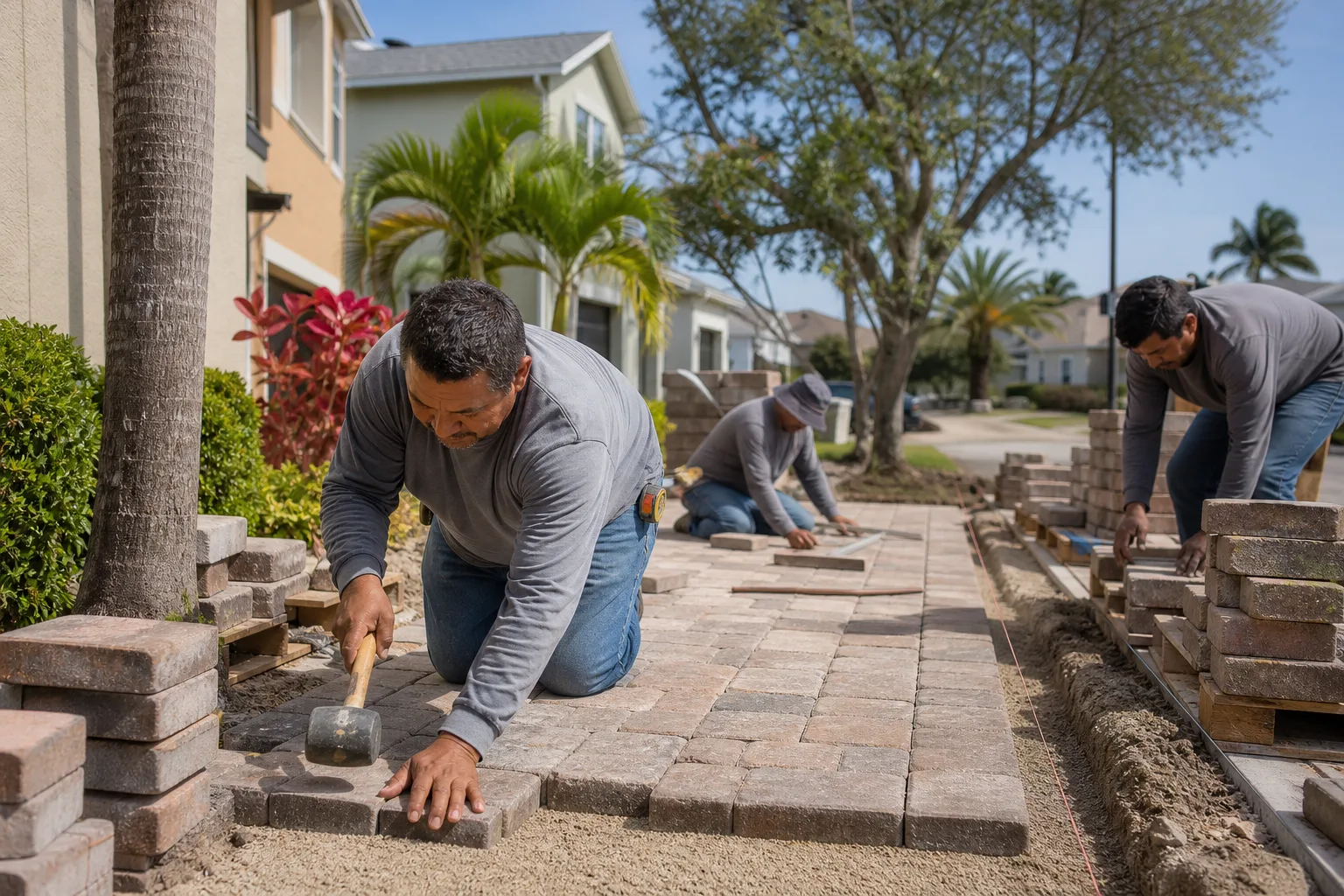
Concrete installs faster on paper (3 to 5 working days from demo to finish) but the timeline isn’t the reason to choose between them. Paver driveways hold up better on Fort Worth’s clay soil because the flexible joints absorb the soil movement that cracks a rigid slab, and individual pavers can be replaced without demolition. A concrete driveway can be a good choice, but if you’re comparing them, compare on 15-year cost and performance, not on install days.
The cost of a paver driveway in Fort Worth runs roughly $12 to $22 per square foot installed, depending on the paver selection, base conditions, and any drainage work. A standard 500 square-foot two-car drive lands between $6,000 and $11,000 for the pavement itself. Concrete sits lower; pavers deliver a longer service life on Texas blackland clay and rarely need to be fully replaced. If you’re planning a home addition that touches your driveway approach, the sequencing gets more complicated; our Home Additions & ADU in Fort Worth page explains how that work sequences with driveway and site work.
Does the Season Affect How Long the Work Takes?
Yes. Fort Worth seasons each hit the schedule differently. Here’s the quick version:
- Spring (March to May): Best working weather, but highest rain risk. Build 2 to 3 rain days into any Fort Worth schedule in this window.
- Summer (June to August): Dry and fast, but joint sand and sealant need early-morning scheduling. Add 1 day for sealant rescheduling if the forecast won’t cooperate.
- Fall (September to November): Ideal. Lowest risk window for a Fort Worth paver install, and the reason most savvy homeowners schedule their work in October.
- Winter (December to February): Shortest daylight, occasional hard freezes, and material lead times that stretch because suppliers are catching up on year-end. Not a bad time to install, just plan for a longer calendar.
If your schedule allows, October through mid-November in Fort Worth is the fastest, most predictable window on the calendar.
See the difference
 Before
 After
 Before
 After
 Before
 After
What About Alternative Construction Methods?
You may have seen modular or prefab construction marketing for larger builds – companies like Cover, Dvele, Mighty Buildings, or Boxabl – that advertise faster timelines because walls and systems arrive on site pre-built. That’s a useful concept for ADUs and home additions, where factory construction genuinely shortens the build calendar. For a driveway, the prep work doesn’t change. The base still has to be excavated, graded, compacted, and edged on-site. Factory-built surfaces don’t compress clay soil. So no matter how fast the product arrives, Fort Worth paver driveways still take the schedule we outlined above.
Common Mistakes to Avoid
- Comparing “install days” instead of “calendar days.” A bid that says “3 days” for the paver laying phase is technically honest but practically misleading. Ask for the whole schedule, sign-to-seal, in writing.
- Signing without a base depth specification. If the bid doesn’t say 6 to 9 inches of compacted base, in 2 to 3-inch lifts, that’s the first thing that gets cut when the schedule tightens. A paver surface over a thin base fails within 18 months in Fort Worth’s clay soil, especially in neighborhoods where the clay expands and contracts.
- Scheduling install during spring storm season without weather buffer. A Fort Worth March job that starts with no rain days built in will slip – not might, will. Insist on 2 rain days per 10 working days between March and May.
- Skipping the 811 utility locate. Texas Utility Locate takes 2 to 3 business days, and a severed gas or cable line adds a full day plus a repair bill. Nothing about the paver schedule is worth skipping the locate call.
- Sealing too early or on a hot day. Sealer applied within 24 hours of install, or on a 100°F+ Fort Worth afternoon, traps moisture and can cloud the finish. Wait until the pavers are dry and the temperature window is right, typically a dry 60 to 80°F day.
- Not confirming HOA approval before ordering materials. We’ve seen Fort Worth homeowners order $4,000 in paver pallets before getting their HOA color approval, then have to sell them on the secondary market because the review board said no.
- Choosing a contractor who won’t itemize the sequence. If the bid has one number and no phases, walk. The sequence is the project, and any builder who won’t break it down either doesn’t know it or doesn’t want you to.
When to Call a Professional
Get a pro involved before you pick up a shovel if any of the following applies: your driveway is on clay soil and has shown any settling or cracking (indicating subbase problems); the existing driveway is concrete thicker than 4 inches (heavy demo); there’s any chance of a buried utility line, septic, or old footing under the footprint; your driveway needs a new curb cut or widening; or your HOA requires color approval. These are the conditions where a DIY install almost always costs more in the long run than it saves on labor. The tools required – plate compactor, wet saw, laser level, screed rails – add up fast, and compaction errors cannot be fixed after the pavers are down.
Groundwork Construction Co. of Fort Worth offers free estimates in Fort Worth – call (855) 912-5373. Live person, 24/7. Background-checked, uniformed technicians. Upfront pricing, no surprises. Our bids include the full phase-by-phase schedule, base depth specification, and material brand, so you can compare like-for-like with any other quote. Financing is available at 0% for 18 months, and projects over $10,000 get $1,000 off. All work is covered by the 730-Day Done Right Promise.
Frequently Asked Questions
A two-car paver driveway in Fort Worth typically takes 6 to 10 working days on-site, plus a 1 to 3-week material ordering window before work starts. A single-car drive runs 3 to 5 days. Long or complex driveways, or those hitting subbase repair, stretch to 2 to 3 weeks. Call (855) 912-5373 for a free estimate that spells out your specific schedule.
No, not correctly. The one-day promise ignores base excavation, lift-by-lift compaction, edge restraint, and joint sand activation – the four phases that determine whether the driveway holds up in Fort Worth clay soil. A one-day install means multiple phases were skipped or combined, and the failure shows up 1 to 3 years later. Call (855) 912-5373 to see a real schedule for your property.
Most Fort Worth driveway replacements on an existing footprint don’t require a permit. Widening the driveway, cutting a new curb, or amending a commercial apron does require a permit, with approval typically taking 2 to 6 weeks. Ask before signing anything. Call (855) 912-5373 to walk through whether your project needs a permit.
The gap is almost always about which phase the contractor was quoting. A “3-day” quote usually means the paver-laying phase only, not the excavation, base prep, and curing that surround it. Ask any Fort Worth paver contractor to give you the full calendar from contract signing to final walkthrough. If they can’t or won’t, that’s what the price difference in their bid is buying. Call (855) 912-5373 for a phase-by-phase schedule.
Extreme heat doesn’t stop excavation or paver laying, but it does affect joint sand activation and sealant. On 100°F+ Fort Worth days, polymeric sand requires early-morning scheduling and a return visit to re-check the surface. Sealer doesn’t apply well above 90°F either, so the sealing appointment gets pushed to a milder day. That adds roughly 1 day to the calendar in the July-August window.
In most cases, foot traffic can resume the same day, and vehicle traffic is fine within 24 to 48 hours of the final compaction – longer if polymeric sand is still curing, and longer still after sealing (typically 24 to 72 hours for sealant to fully cure). A short delay here is worth it: pushing a 3,500-pound truck onto a curing joint sand bed will rut it. Call (855) 912-5373 to schedule a free estimate.
The Bottom Line
Most homeowners underestimate paver driveway timelines because they’re comparing phase quotes against project quotes. In reality, a Fort Worth two-car driveway takes 6 to 10 working days on-site, plus a 1 to 3-week material lead time, plus 1 to 2 weather buffer days during storm season. Rigid base preparation – at least 6 inches, compacted in 2 to 3-inch lifts – is where the project either holds up or fails in Fort Worth’s clay soil. Rush it and you’ll be pulling pavers within 2 years. Do it right and the surface will outlast the mortgage. If you’re ready for a real schedule from a Fort Worth paver contractor with the 730-Day Done Right Promise, call (855) 912-5373.
Ready to Price Your Fort Worth Paver Driveway?
Call (855) 912-5373 for a free estimate – a live person answers 24/7, no voicemail, no waiting until Monday. We’ll walk your Fort Worth property, measure the base conditions, and give you a written phase-by-phase schedule with itemized pricing. Projects over $10,000 get $1,000 off, and 0% financing for 18 months is available. Every installation is covered by the 730-Day Done Right Promise. Get the real number, not the sales number.
Written by the team at Groundwork Construction Co. of Fort Worth.