
Last updated November 18, 2026
Free written scope consultation - allowances, timeline, and change-order rules on paper before a single trade is scheduled
The Complete Driveway & Pavers Guide for Fort Worth Homeowners
Fort Worth sits on one of the most expansive clay soils in the country, and that same soil that cracks foundations will quietly destroy a paver driveway built on a standard installation spec. The Blackland Prairie clay under most of Tarrant County swells when it’s wet and shrinks when it’s dry, moving inches across a season. A paver driveway that looks perfect in April can heave, rut, and shed its base by the second August. This guide covers what actually holds up in Fort Worth: how deep the base needs to go, which materials survive our heat and freeze-thaw swings, what permits and HOA rules apply, what things cost here rather than nationally, and the bid questions that separate a serious installer from a shortcut artist.
Quick Answer
A paver driveway in Fort Worth typically costs $12 to $22 per square foot installed, and the single biggest factor in whether it lasts is base preparation, not the paver style you pick. Because of Fort Worth’s expansive clay, a driveway here needs a deeper, geotextile-stabilized base than national installation guidelines call for, usually 8 to 12 inches of compacted crushed stone rather than the 4 to 6 inches in a generic paver manual. Get the base right and a quality paver driveway runs 25 to 30 years. Skip it and you’ll be releveling within three.
Styles & brands we work with
- Kitchen remodeling
- Bathroom remodeling
- Home additions & ADU
- Roofing
- Windows & doors
- Driveway & pavers
- Fence
Table of Contents
- Why Fort Worth Clay Demands a Deeper Base
- Matching Paver Material to Fort Worth Heat and Freeze-Thaw
- Permeable Pavers and Drainage in North Texas
- Permits and HOA Rules in Fort Worth and Tarrant County
- What Driveway Pavers Cost in Fort Worth
- How to Read a Contractor Bid
- Common Mistakes to Avoid
- When to Call a Professional
Why Fort Worth Clay Demands a Deeper Base Than National Standards
Most paver installation guides in circulation were written for sandy or gravelly soils, where a 4-inch compacted base is genuinely fine. Fort Worth is not that. The Blackland Prairie clay running through Tarrant County contains montmorillonite, a mineral that absorbs water and expands dramatically. During a wet spring, that clay can push up by an inch or more under a driveway. Through a dry August, it shrinks and pulls away, leaving voids. A paver surface laid over a thin base simply follows the ground beneath it, and that means rocking, sunken tire tracks, and open joints within a couple of seasons.
The fix is a base engineered for movement: a deeper excavated profile, a woven geotextile separation fabric, and staged compaction of crushed stone in lifts. In our experience across Fort Worth, the difference between a driveway still flat after eight years and one that’s rutted after two comes down almost entirely to how the base was built.
What a Fort Worth base build should look like
- Excavate to 10 to 14 inches below final paver grade, not the 6 to 8 inches in a generic national spec.
- Proof-roll and recompact the subgrade so you find soft spots before stone goes down, not after.
- Lay a woven geotextile separator between clay subgrade and stone to stop fines from pumping up into the base.
- Place 8 to 12 inches of crushed stone in 3- to 4-inch lifts, compacting each lift with a plate compactor.
- Finish with 1 inch of bedding sand over the compacted base, screeded dead flat with proper fall toward drainage.
- Vibrate pavers into the bedding and sweep polymeric joint sand in once the surface is set.
An installer who can walk you through that sequence, with numbers, is worth talking to. One who says “we use the standard base” on Fort Worth clay is telling you something.
Matching Paver Material to Fort Worth Heat and Freeze-Thaw
Fort Worth throws a wide range at a driveway: triple-digit summers that bake surfaces, and winter swings that push below freezing at night and back above by afternoon. That freeze-thaw cycling, repeated dozens of times each winter, is what breaks down the wrong material. The right paver absorbs that movement without spalling or cracking.
Concrete pavers
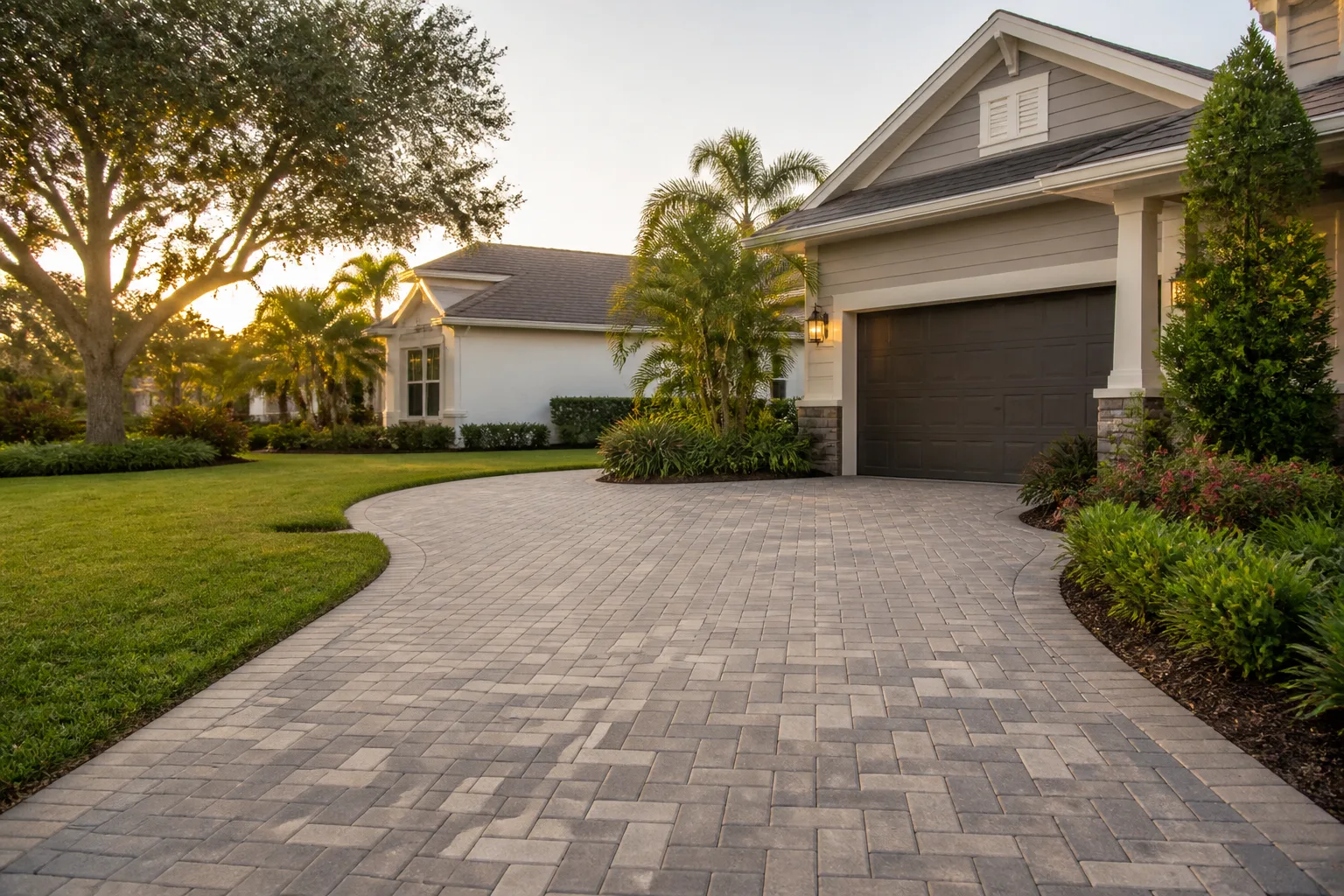
The workhorse choice for most Fort Worth driveways. Interlocking concrete pavers handle our heat and freeze-thaw well, come in dozens of colors and shapes, and run in the mid range on price. Look for a paver rated for freeze-thaw resistance and a compressive strength north of 8,000 psi. Brands like Belgard are common here for good reason: the product holds up and replacement units stay available years later.
Clay brick pavers
Brick is the classic look for older Fort Worth neighborhoods, and a well-fired clay brick is essentially immune to sun fading. The catch is that brick is heavier, costs more installed, and cheap brick spalls in freeze-thaw. If you want the brick look, confirm the units are rated for exterior paving rather than wall use.
Natural stone
Travertine, limestone, and sandstone give a high-end look but demand more care in North Texas. Some limestone varieties are too porous for a driveway and stain or pit under our sun. Sandstone can delaminate in freeze-thaw. Natural stone can work beautifully in Fort Worth, but only with a stone selected for exterior paving and a base that keeps water from sitting under it.
Permeable pavers
Permeable systems let water drain through the surface into a stone reservoir below. They’re a strong fit for Fort Worth lots with drainage problems or tight setbacks, but they live or die on the base. A permeable driveway needs an even deeper open-graded stone reservoir than a standard build, since that reservoir both stores and infiltrates stormwater.
- Concrete pavers: mid price, broad color range, easiest to source replacements
- Clay brick: premium look, sun-stable color, watch for freeze-thaw rating
- Natural stone: highest cost, needs a stone rated for exterior paving in this climate
- Permeable: best drainage story, deepest base requirement, HOA and city rules vary
Permeable Pavers and Drainage in North Texas
Fort Worth gets most of its rain in bursts, and a driveway that sheds water toward the house or a neighbor’s lot creates problems fast. Permeable pavers are one answer, but they’re not a universal one. Our clay subgrade drains slowly, so a permeable driveway here needs a storage reservoir sized to hold stormwater long enough for the clay to accept it, plus an overflow path for the big storms. That’s a design decision, not a product decision.
Whether permeable pavers are even allowed depends on your lot and your HOA. Some Fort Worth neighborhoods restrict surface materials to specific looks, and a permeable system still has to win that approval. Where permeable isn’t a fit, grading and a properly built base with clear fall away from the structure do most of the drainage work. We’ve seen more Fort Worth driveways fail from water pooling at the low corner than from any material problem.
If your driveway ties into a broader drainage or grading plan, it’s often worth looking at it alongside other site work. Our Driveway & Pavers in Fort Worth page covers how we tie surface, base, and drainage together on a single project.
Permits and HOA Rules in Fort Worth and Tarrant County
Replacing a driveway surface in kind, with the same footprint, often doesn’t require a permit in Fort Worth. Widen it, change the grade, add a retaining wall, or alter how stormwater leaves the property, and the picture changes. The City of Fort Worth Development Services department handles residential right-of-way and drainage questions, and a driveway that meets a public street usually has a defined approach and apron standard you can’t change without approval.
What to confirm before work starts
- Right-of-way limits: know where the city’s right-of-way begins so your new driveway doesn’t creep into it.
- Drainage impact: any change that pushes water onto a neighboring lot or into the street can trigger review.
- Retaining walls: walls above a modest height typically need a permit and may need engineered design.
- HOA approval: many Fort Worth HOAs require written approval for material, color, and width before a single paver is ordered.
Common Fort Worth HOA restrictions on driveway materials
Homeowners associations in Fort Worth vary widely, but a few rules show up again and again: approved color palettes (often earth tones, tan, or gray), limits on exposed aggregate or plain gray concrete, required borders or soldier courses, minimum driveway widths, and sometimes a ban on certain natural stones that stain. Get the HOA’s material guidelines in writing first. An installer who asks you for the HOA packet before quoting knows what they’re doing. A written, line-item quote that also lists what permits and approvals you’ll need keeps everyone honest, and it’s the kind of upfront pricing we put in writing on every project.
What Driveway Pavers Cost in Fort Worth
National average pricing won’t help you budget in Fort Worth, because labor rates, stone sourcing, and the deeper base our clay requires all push the real number higher than what a generic cost calculator shows. Here’s what we see in the Fort Worth market, as installed ranges including base, material, labor, and joint sand.
- Concrete pavers, standard: $12 to $17 per square foot installed
- Concrete pavers with premium color or border: $16 to $20 per square foot
- Clay brick pavers: $16 to $24 per square foot
- Natural stone pavers: $20 to $30 per square foot and up, depending on stone
- Permeable paver system: $18 to $28 per square foot, driven by reservoir depth
- Base build and compaction (the part that matters): roughly 30% to 40% of the total, more on lots with poor subgrade
For a typical two-car Fort Worth driveway in the 400 to 600 square foot range, concrete pavers generally land between $5,500 and $10,500 installed once the deep base is included. A larger circular drive or a natural stone job can easily double that. Where a standard bid looks unusually cheap, the missing money is almost always the base.
On larger projects, two standing offers make the numbers easier: $1,000 off projects over $10,000, and 0% financing for 18 months, so a full driveway plus other site work can be spread out without interest. We put every one of those figures in a written, line-item quote before work starts. The number you see is the number you pay.
How to Read a Contractor Bid: The Base Prep Questions
The paver is the visible product, but the base is the actual job. A bid that names a paver and a price but says nothing about excavation depth or compaction is a red flag. Ask these questions before you sign anything, and expect specific answers.
- “How deep will you excavate, and how much crushed stone goes in?” A serious Fort Worth installer answers with a number, usually 8 to 12 inches of base. “Standard base” is not an answer.
- “Will you use geotextile fabric between the clay and the stone?” On our clay, it’s a yes.
- “How do you compact, and in how many lifts?” Stone should go in lifts and be compacted each one, not dumped and topped.
- “How do you handle drainage and slope?” Ask where the water goes and how the finish grade falls.
- “What joint sand, and is it polymeric?” Polymeric sand locks joints and resists washout.
- “What’s the workmanship warranty in writing?” A real guarantee covers labor and base, not just the paver material.
- “Are you licensed, insured, and pulling any needed permits?” Get the certificate before work begins.
For reference, our own workmanship is covered by the 730-Day Done Right Promise: if it isn’t done right, we make it right. That’s one of the longest workmanship guarantees in residential construction, and it’s why the base questions above matter to us. Built to last, backed in writing.
Read two or three bids side by side and you’ll usually find one that answers all seven questions in specifics and one or two that stay vague. The vague ones are cheap for a reason.
Common Mistakes to Avoid
- Building on a thin base. A 4-inch base copied from a national guide will fail on Fort Worth clay. Insist on the deeper, stabilized build.
- Skipping the geotextile separator. Without fabric, clay fines migrate up into the stone and the base stops draining and starts moving.
- Picking pavers before checking HOA rules. Ordering a color your Fort Worth HOA rejects means eating the cost or tearing out new work.
- Ignoring drainage. A flat or backward-sloped driveway sends water toward the house or a neighbor’s lot, and no paver survives standing water.
- Choosing the cheapest stone regardless of climate rating. Porous limestone or unrated brick can pit and spall through our freeze-thaw cycles.
- Accepting a verbal warranty. “We’ll take care of you” is not a guarantee. Get the workmanship term in writing before signing.
- Paying a large deposit with no written scope. A line-item quote protects you; a handshake and a big check up front usually doesn’t.
When to Call a Professional
Some driveway work is genuinely do-it-yourself: patching a single settled paver, or refreshing joint sand. The moment the job involves excavation, base engineering, or drainage changes, it stops being a weekend project. On Fort Worth clay, a driveway that’s failing across multiple pavers, holding water, or separating from the foundation edge needs an experienced eye, because the fix is almost always in the base, not the surface. The same is true if you’re widening the driveway, adding a retaining wall, tying into a new drainage plan, or dealing with an HOA that wants material approvals in writing. Those jobs reward a properly built base and a workmanship warranty that means something.
Groundwork Construction Co. of Fort Worth offers free estimates in Fort Worth. Call (855) 912-5373 and a live person answers, any hour, any day. We’ll walk the driveway, talk through the base build, and put the numbers in writing so you can compare bids fairly.
See the difference
 Before
 After
 Before
 After
 Before
 After
Frequently Asked Questions
A paver driveway in Fort Worth runs about $12 to $22 per square foot installed, depending on material and base conditions. A typical two-car driveway lands around $5,500 to $10,500. Call (855) 912-5373 for an exact quote; estimates are free.
Fort Worth’s expansive clay soil swells when wet and shrinks when dry, and a thin base over that movement causes heave and settlement. The cure is a deeper, geotextile-stabilized base, usually 8 to 12 inches of compacted stone. If your pavers are already moving, call (855) 912-5373 for an assessment.
Interlocking concrete pavers are the most reliable all-around choice for Fort Worth’s heat and freeze-thaw cycles, with clay brick and properly selected natural stone as premium options. What matters most is a paver rated for exterior paving in a freeze-thaw climate, on a properly built base.
A like-for-like driveway replacement often doesn’t need a permit, but widening, regrading, retaining walls, or drainage changes usually do. Fort Worth also has right-of-way and stormwater rules near public streets. Confirm with the City of Fort Worth Development Services before work begins, and get any permits pulled and inspected.
With an upfront, line-item quote, the price you sign is the price you pay; there are no surprise change orders. On our projects the number you see is the number you pay. Call (855) 912-5373 to schedule a free estimate and get the scope in writing.
A quality paver driveway built on a properly engineered base lasts 25 to 30 years in Fort Worth, while one on a thin base can need releveling within two or three. The pavers themselves often outlast the base, so the base is where the longevity is won or lost.
The Bottom Line
Paver driveways in Fort Worth succeed or fail on the ground beneath them. Fort Worth’s Blackland Prairie clay demands a deeper, geotextile-stabilized base than any national spec recommends, and that base is the single biggest driver of cost and longevity. Match the paver to our heat and freeze-thaw cycles, confirm HOA and city rules before ordering a single unit, budget for local pricing rather than national averages, and ask every installer exactly how they’ll build and compact the base. Do those four things and you’ll get a driveway that’s still flat a decade from now. Skip them and you’ll be releveling a two-year-old surface.
When you’re ready for numbers in writing, from foundation to finish line, Groundwork Construction Co. of Fort Worth is here. Our technicians have up to 12 years of experience, arrive background-checked and in uniform, and every job is backed by the 730-Day Done Right Promise. Call (855) 912-5373 for a free estimate and design consult on your Fort Worth driveway.
Thinking beyond the driveway? Explore our Groundwork Construction Co. of Fort Worth home page, our Fence Installation in Fort Worth service if your site work includes fencing, and our Home Additions & ADU in Fort Worth team if you’re planning a larger build on the same property.
Written by the team at Groundwork Construction Co. of Fort Worth.


