
Free written scope consultation - allowances, timeline, and change-order rules on paper before a single trade is scheduled
Styles & brands we work with
- Kitchen remodeling
- Bathroom remodeling
- Home additions & ADU
- Roofing
- Windows & doors
- Driveway & pavers
- Fence
See the difference
 Before
 After
 Before
 After
 Before
 After
What Is Low-E Glass? The Answer That Matters on a 104°F Fort Worth Afternoon
Low-E glass is window glass with an invisible, microscopic metallic coating that reflects heat-producing infrared radiation back outside while letting visible light pass through. If you’ve stood next to a west-facing window in Fort Worth in August and felt like you were standing near a heat lamp, that’s solar infrared load pouring through uncoated glass, and a low-E coating is the specific technology that blocks most of it. In Fort Worth’s climate, the correct choice is almost always a solar-control (soft-coat) low-E, not a passive (hard-coat) one. Here’s what that actually means for your home, and when it’s worth a call to (855) 912-5373.
The Two Types of Low-E Coating (and Why Most Pages Blur Them)
Almost every explainer online describes “low-E glass” as if there’s one product. There are two, and they do opposite jobs.
- Passive low-E (hard-coat): Applied while the glass is still hot, this coating lets more of the sun’s heat in. It’s designed for cold climates where winter solar gain is a benefit. In Fort Worth, that’s the wrong tool. It traps heat you’re paying to remove.
- Solar-control low-E (soft-coat): Deposited in a vacuum sputter process, this is a multi-layer coating that blocks infrared and ultraviolet while still transmitting visible light. This is the coating built for North Texas, where summer cooling load dwarfs any winter heating benefit.
At the core of solar-control glass is SHGC, or solar heat gain coefficient. A standard clear double-pane unit runs roughly 0.70 to 0.80 SHGC, meaning about three-quarters of the sun’s heat energy comes into your home. A good solar-control low-E unit drops that to around 0.25 to 0.30. That gap is the whole argument.
What The Coating Actually Does on a West Window in Fort Worth
Picture a mid-century brick ranch in a neighborhood off Loop 820, a west wall taking direct afternoon sun from 2 p.m. until sundown. A single west-facing double-pane window without low-E is radiating somewhere in the neighborhood of 600 to 900 BTUs per hour of heat into the room on a 104°F day. That’s roughly the output of a small space heater pointed at your couch. Add four or five windows on that wall and you’re fighting thousands of BTUs per hour with your air conditioner.
Put solar-control low-E on the same glass and that infiltrating radiant load drops by 60 to 75 percent. The room doesn’t just feel cooler when you stand by the window. The AC runs shorter cycles, and the hot-spot near the west wall stops driving the thermostat. That’s the practical, measurable difference, not a vague “energy efficiency” claim.
Will Low-E Glass Make My Windows Look Dark or Tinted?
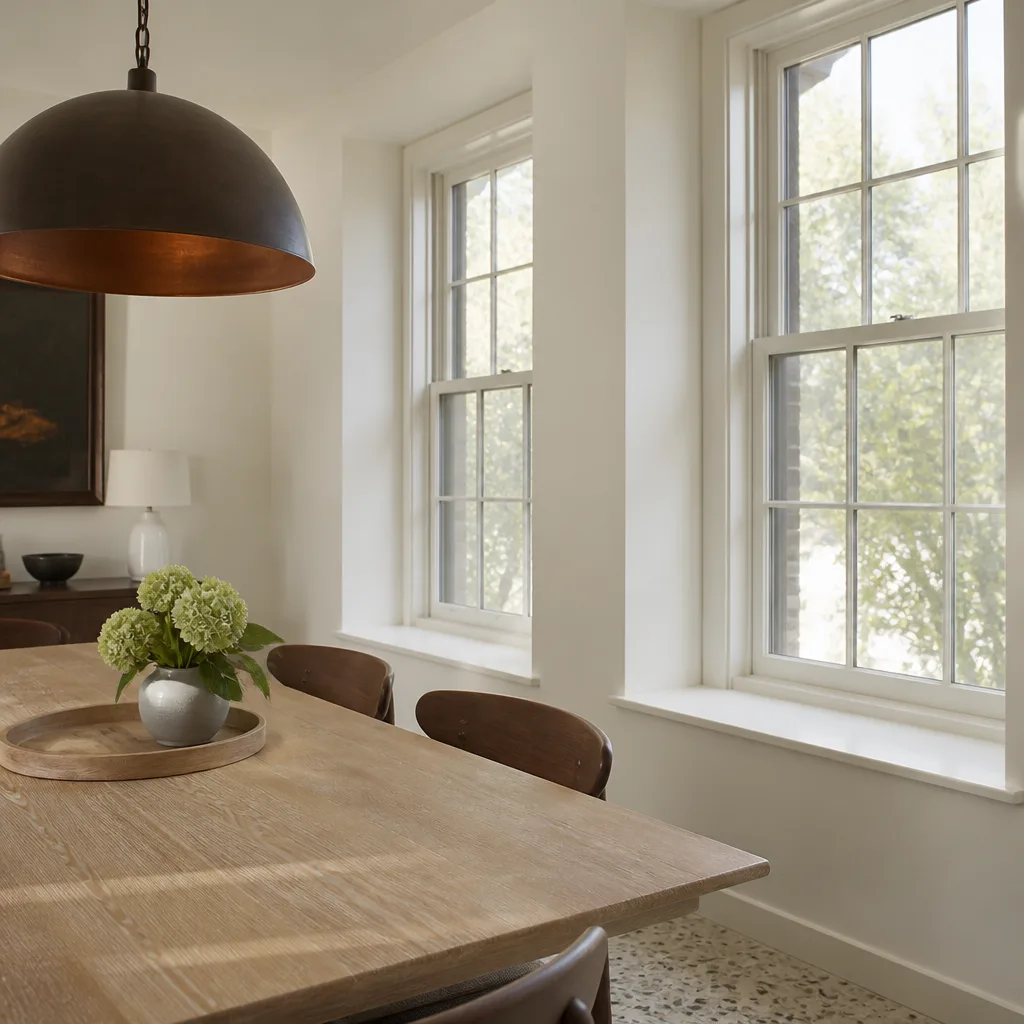
This is the fear that stops homeowners from ordering it, and the answer is no, not if the glass is specified correctly. Visible light transmittance (VT) on the Andersen and Marvin low-E lines we work with typically runs in the 0.50 to 0.65 range, meaning you still get 50 to 65 percent of daylight through the pane. Compare that to clear glass at about 0.70 to 0.80 and the difference is subtle: a slight warm or faint tint you notice on a bright day, not a smoked-glass look.
Here’s the tradeoff most pages skip: on a fixed window budget, VT and SHGC pull against each other. The harder you block heat, the more visible light you give up. For Fort Worth’s west-facing exposures, we generally recommend giving up a little light to get the heat rejection, because that wall is your biggest cooling problem. For a shaded north window, we can spec a higher-VT glass and keep it bright. Specifying glass by compass direction, not one blanket product across the house, is the difference between comfort and compromise.
Why We Specify Andersen and Marvin Low-E Glass Over Commodity Units
The coating is only as good as the factory that applies it. Andersen and Marvin low-E lines carry coating durability and quality control that commodity window packages don’t: coatings applied in a controlled sputter line, edges sealed on a factory line, and a warranty that holds up. A bargain glass unit might spec the same “low-E” number and still fail at the seal within a few seasons. When you’re choosing Windows & Doors for a home you plan to stay in, the coating process is worth more than the marketing label. Our technicians have up to 12 years of experience specifying and installing these lines, and every project is covered by our 730-Day Done Right Promise: if the work isn’t right, we make it right.
The Detail No Other Low-E Page Mentions: Clay Soil and Gas Loss
Fort Worth’s expansive black clay soils move with the seasons. Slab and pier-and-beam foundations alike shift, and when they do, window frames flex with them. That flex can eventually compromise the seal on a dual-pane insulated glass unit, letting the argon or krypton gas slowly leak out. The lost gas costs you some insulating value, but here’s the point: the low-E coating is bonded to the glass surface itself, so it keeps reflecting infrared heat even after the seal has degraded. That’s a real durability argument in a city where foundations move, and it’s the reason we don’t sell low-E as a fragile add-on. It’s a coating that survives in a house that settles.
What Low-E Glass Costs in Fort Worth
Low-E is an upgrade inside a window replacement, not a separate line item, so the best way to budget is to price the full job. Here are the market ranges for Fort Worth:
| Window Project | Price Range |
|---|---|
| Window Replacement (low-E included) | $4,500-$15,000 |
| Impact Window Installation | $8,000-$25,000 |
| Roof Replacement (for context on spring hail cycle) | $8,000-$20,000 |
Across a whole-home window package, adding low-E typically adds a modest percentage to the per-window price versus clear glass, and the cooling-load reduction on west and south exposures pays it back over time. Upfront pricing means the number you see is the number you pay, and there’s $1,000 off projects over $10,000 plus 0% financing for 18 months if a full replacement makes sense.
A note on whether it fits your home
Most Fort Worth homes are strong candidates for solar-control low-E, but not every window needs the same spec. A shaded north window, a room you rarely cool, and a full-sun west wall all call for different glass. Our team specs by exposure, and it’s worth talking through before you commit.
FAQs
Yes. With North Texas summers routinely pushing well past 100°F, solar-control low-E on west and south facing windows cuts radiant heat into the room by roughly 60 to 75 percent versus clear double-pane glass, and that directly reduces AC runtime and the hot-spot near sunny walls. It’s most worth it on a home with large or west-facing windows that make rooms uncomfortable in the afternoon. Call (855) 912-5373 for a free estimate on your specific windows.
Not significantly. Most Andersen and Marvin low-E lines let 50 to 65 percent of visible light through (VT), compared to about 70 to 80 percent for clear glass, so the difference is a slight tint rather than a dark room. On a north or shaded window we spec higher-VT glass to keep it bright; on a full-sun west wall we trade a little light for much better heat rejection. Call (855) 912-5373 and we’ll spec each exposure to your comfort.
The coating itself is bonded to the glass and keeps reflecting infrared even if the dual-pane seal degrades, though the insulating gas between the panes can still leak. In Fort Worth, foundation movement in our expansive clay soils flexes frames and is a common cause of seal failure over time, which is why the glass coating’s durability matters here. Call (855) 912-5373 if a window you already have looks foggy or cloudy.
Soft-coat (solar-control) low-E is the right choice for Fort Worth. Hard-coat is designed for cold climates where you want winter sun to warm the home; in North Texas that heat becomes a cooling bill, so solar-control glass with a low SHGC is the correct spec for most windows. Call (855) 912-5373 for a walkthrough of what your home’s exposures actually need.
If you’d rather have it looked at, Groundwork Construction Co. of Fort Worth offers a no-pressure assessment in Fort Worth. Every visit includes an estimate and design consult, and our technicians are background-checked and show up in uniform. We answer live, 24/7. Call (855) 912-5373 to get started.
Written by the team at Groundwork Construction Co. of Fort Worth, serving Fort Worth, TX.


