
Last updated November 18, 2026

Free written scope consultation - allowances, timeline, and change-order rules on paper before a single trade is scheduled
Driveway & Pavers Maintenance Schedule: What to Do and When
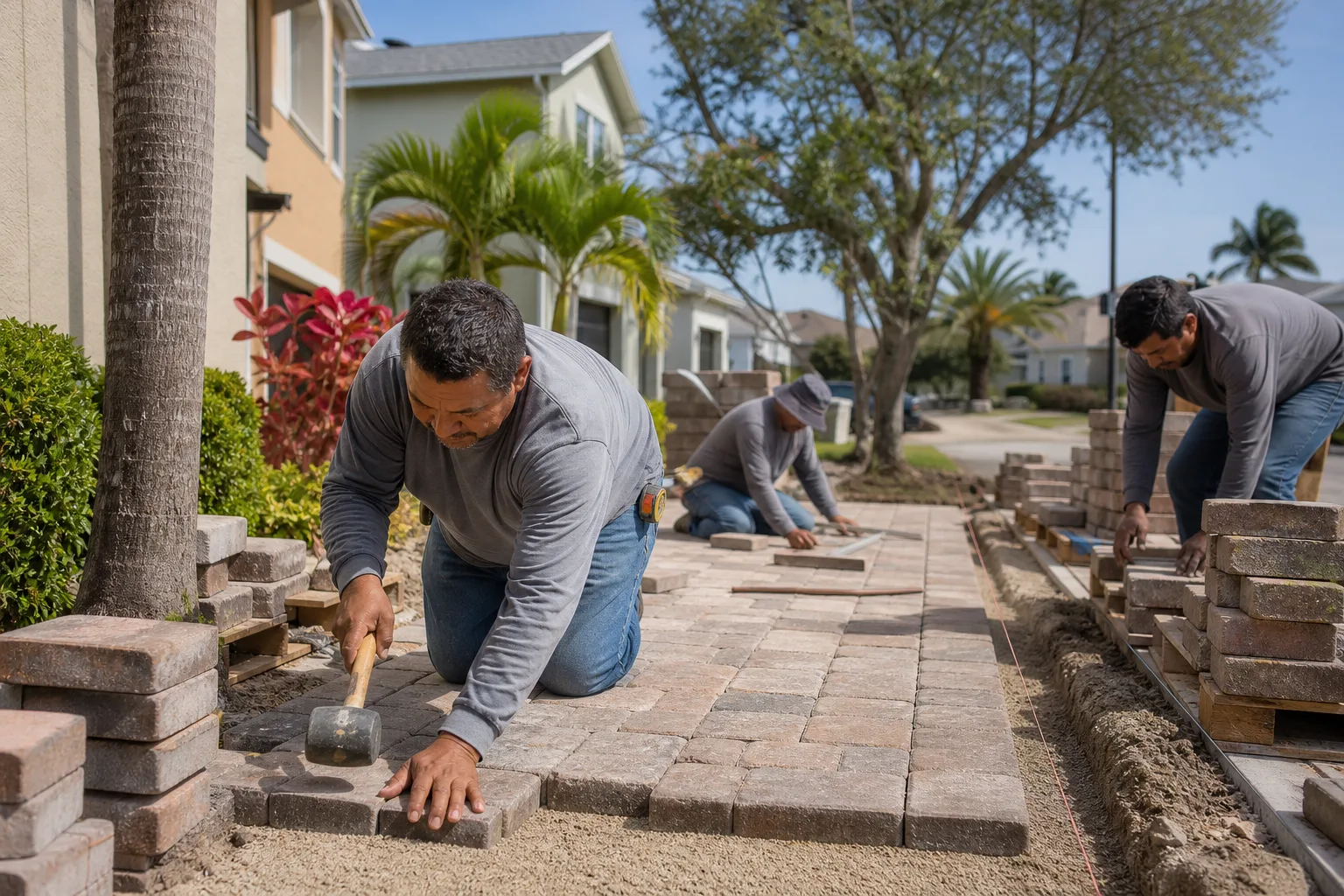
The number one reason paver driveways fail early isn’t the installation. It’s homeowners hosing them down with a pressure washer every spring, blasting out the joint sand, and calling that maintenance. We’ve torn out eight-year-old paver drives in Fort Worth that were set on a perfect base and still heaved, shifted, and grew weeds because the surface was treated like a slab of concrete. Pavers aren’t concrete. They’re a system – stone, sand, base, and sealer working together – and that system has a seasonal rhythm that almost nothing else on your property shares. This guide lays out exactly what to do month by month, so you’re maintaining the system instead of slowly destroying it.
Quick Answer
A paver driveway in Fort Worth needs a light inspection monthly, joint sand topped off once or twice a year (more after heavy rain seasons), a full re-sanding every two to three years, and resealing every three to five years – never more often than every three years. Pressure washing above 1,500 PSI is the fastest way to ruin a paver drive. Everything else is calendar work you can plan around North Texas weather.
Styles & brands we work with
- Kitchen remodeling
- Bathroom remodeling
- Home additions & ADU
- Roofing
- Windows & doors
- Driveway & pavers
- Fence
Table of Contents
- Why Paver Driveways Fail in Fort Worth (and Why Concrete Habits Are the Culprit)
- The Fort Worth Paver Maintenance Calendar: Month by Month
- Joint Sand: The Correct Refill Process and How Often Fort Worth Actually Needs It
- The 10-Minute Inspection That Catches Joint Erosion Early
- Resealing Pavers: When to Seal, and Why Over-Sealing Causes More Problems Than Under-Sealing
- What Kills Paver Driveways in Fort Worth Specifically
- Cleaning Without Destroying: Pressure, Chemicals, and Hard Water
- Repair or Replace? How to Read the Signs
Why Paver Driveways Fail in Fort Worth (and Why Concrete Habits Are the Culprit)
A concrete driveway is a single poured mass. You clean it, you seal it if you feel like it, and when it cracks you patch it. Pavers are the opposite: thousands of individual units held in place by interlocking geometry and a sand joint. The joint sand is not decoration. It’s the friction layer that keeps each paver from moving against its neighbor. Strip the sand out and every tire roll, every summer expansion, every winter freeze-thaw cycle nudges individual units out of plane.
That’s why a Fort Worth paver drive that gets pressure-washed hard every March starts showing rutting by year five and full joint washout by year eight. The stone is fine. The sand is gone. And once the sand is gone, water gets under the pavers instead of running off them.
Fort Worth makes this worse than most markets. Our soil is a mix of expansive clay and limestone depending on where you sit – the Blackland Prairie clay in areas like Arlington Heights and Ridglea swells and shrinks dramatically with our wet-spring/dry-summer pattern. A paver system that’s properly sanded and sealed rides that movement. One that isn’t starts telegraphing the base failure within a season or two.
On top of that, Fort Worth summers hit 100°F regularly, and UV exposure degrades cheap sealers fast. A homeowner who resealed every year with a big-box acrylic product would actually be worse off than one who never sealed at all – more on that below. If you’re starting from scratch rather than maintaining an existing drive, our team at Driveway & Pavers in Fort Worth builds these systems from the base up, and the spec matters as much as the maintenance.
The Fort Worth Paver Maintenance Calendar: Month by Month
Generic “spring and fall” advice doesn’t work here because Fort Worth’s seasons don’t line up with the rest of the country. Our heaviest rain is spring (April – May), our worst heat is July – August, our freeze risk is January – February, and our worst leaf and pollen drop is November – December. Here’s the calendar we actually recommend to homeowners:
- January: Post-freeze inspection. Walk the drive after any hard freeze and look for heaved pavers or new cracks in the joints. Freeze-thaw is when base failures first show.
- February: Check irrigation heads for misalignment – winter dormancy is the easiest time to spot and fix a head that’s spraying the drive instead of the lawn.
- March: Rake out winter debris, spot-check joint sand depth (it should sit roughly 1/8 inch below the paver surface), and top off any low spots. Do not pressure wash in March unless you plan to re-sand immediately.
- April – May: Heavy rain season. Inspect after every storm for sand washout at the low end of the drive, near the street apron, and along any grade change.
- June: Full joint sand refill if you skipped the spring top-off. Pre-summer is the ideal window because the sand settles before the heat.
- July – August: Check for UV fading and sealer edge-lift. These are the months when a degraded sealer starts turning chalky. Avoid heavy cleaning in peak heat.
- September: Best month of the year for resealing in Fort Worth. Temps are 75 – 85°F, humidity is dropping, and you get a full cure window before fall rain.
- October: Deep-clean any organic staining (mildew, algae, leaf tannin) before it sets. Weeds are actively trying to establish in the joints this month.
- November – December: Leaf and pollen season. Rake or blow weekly. Oak leaves in particular leave tannin stains if they sit wet against pavers for more than a few days.
Print that calendar and stick it inside the garage door. The pattern is the whole game – miss the June sand refill and the September reseal and you’ll pay for it in repair work later.
Joint Sand: The Correct Refill Process and How Often Fort Worth Actually Needs It
Joint sand is the single most important maintenance item on a paver driveway, and it’s the one most homeowners either skip or do wrong. In Fort Worth, plan on a light top-off every six to twelve months and a full re-sand every two to three years. If your drive catches a lot of runoff from a slope or sits at the low point of the street, expect the top-off more often than that.
The wrong sand is almost worse than no sand. Do not use play sand or mason sand. You need a proper polymeric joint sand or a #30-grade washed sand designed for paver joints. Polymeric sand hardens slightly when wet and resists washout much better than plain sand, which is why we default to it in Fort Worth where summer thunderstorms can drop two inches in an hour.
Here’s the correct process:
- Clean the joints first. Sweep, blow with a leaf blower on low, and pull any weeds with a weeding knife. Don’t try to sand over debris.
- Pour sand in small piles across the drive rather than one giant pile. Roughly one 50-pound bag covers 40 to 60 square feet for a top-off.
- Push the sand into the joints with a stiff broom at a 45-degree angle to the joint. Work in sections, not all at once.
- Vibrate the sand in – a plate compactor on a rubber pad is the proper tool, but a hand tamper works for a top-off. This is what actually seats the sand. Sweeping alone doesn’t.
- Refill any joints that dropped below the target depth, then sweep off the excess.
- For polymeric sand, mist lightly with a hose to activate the binder, then keep foot and vehicle traffic off for 24 hours.
If your drive has been losing sand faster than you can add it – say, after every rain, not just the big ones – that’s a sign the joints are wider than they should be or the base is shifting, and it’s time for a professional look. We see this pattern constantly in Fort Worth drives that were laid with insufficient edge restraint on the street side.
The 10-Minute Inspection That Catches Joint Erosion Early
Ten minutes, once a month, is all it takes to catch the problems that become expensive if they’re left for a season. Do this walk on a dry day, ideally in the morning before the sun’s been on the drive long enough to hide shadows.
- Walk the perimeter slowly. Look at the edge restraint on all four sides. Any gap between the restraint and the pavers wider than a credit card is a joint erosion problem in progress.
- Look for “sand trails.” A line of sand at the bottom of the drive or in a corner is what the last rain washed out. That’s where sand is leaving the system.
- Check joint depth in five random spots. Poke a key or a screwdriver into the joints. If it sinks more than 1/4 inch before hitting compacted material, top off.
- Scan for rocking pavers. Step on the center of a half-dozen pavers spread across the drive. Rocking means base movement, not surface movement.
- Check the street apron and any grade change. These are the two places where water velocity is highest and sand loss is fastest.
- Look for weed sprouts. Weeds in joints are a symptom, not a cause. They tell you the polymeric sand has broken down and the joint is open.
- Photograph anything that looks off. A photo from March compared to the same spot in September shows you exactly how much sand you’re losing per season – and tells you when it’s time to call.
If you find more than two of these on a single walk, schedule a professional inspection. A small repair at that stage is a few hundred dollars. A base rebuild of half the drive is not.
Resealing Pavers: When to Seal, and Why Over-Sealing Causes More Problems Than Under-Sealing
Resealing is where most Fort Worth homeowners do the most damage, in part because the industry markets sealer like sunscreen. It isn’t. Sealer is a sacrificial wear layer. Applied wrong or too often, it traps moisture under a plastic film, turns cloudy, delaminates in sheets, and creates a surface that looks worse than unsealed pavers ever would.
The right interval in Fort Worth is every three to five years. Not annual. Not every other year. Three years minimum between coats, and longer is fine. Our climate is dry enough November through February that a well-applied quality sealer earns its keep for four years without breaking a sweat, provided the pavers are properly prepped.
Watch for these signals that it’s time:
- Water no longer beads on the surface – instead it darkens the pavers within seconds of contact.
- The color has gone flat or chalky, especially on the sun-facing half of the drive.
- You can see the sealer lifting at edges or joints.
- Mildew and algae are establishing faster than usual.
When it’s time, prep matters more than product:
- Clean thoroughly with a low-pressure washer (under 1,500 PSI) and a paver-specific cleaner. Never use a turbo tip.
- Let the pavers dry for at least 48 hours in Fort Worth summer heat, longer in cooler months.
- Re-sand the joints if needed before sealing, not after.
- Apply sealer in two thin coats rather than one heavy coat. Thick coats are where clouding comes from.
- Don’t seal within 72 hours of rain in the forecast – and in Fort Worth spring, that means scheduling in September, not April.
The most common mistake we see: a homeowner decides to “refresh” the sealer every year because it looks a little dull. Three years of annual coats builds up a film that has to be chemically stripped before it can be redone properly. Under-sealing is a maintenance issue. Over-sealing is a repair bill.
What Kills Paver Driveways in Fort Worth Specifically
Every market has a short list of “this is what actually fails here.” In Fort Worth, it’s these four:
UV degradation of sealer
A Fort Worth summer delivers roughly 6.5 to 7 kWh/m² of daily solar energy in June and July – enough to break down cheap acrylic sealers in two seasons. A quality solvent-based or polyurethane sealer holds up three to four. If you’re buying sealer off the shelf at a big-box store and the label doesn’t name the UV-resistance spec, you’re sealing a drive that gets 220-plus days of sun with a product designed for Seattle.
Oleander and oak tree root pressure
Live oaks and oleander are everywhere in established Fort Worth neighborhoods – TCU area, Ryan Place, Mistletoe Heights, Monticello. Both are notorious for shallow, aggressive root systems. A live oak twenty feet from the drive will push its roots under the edge restraint within a decade and start lifting pavers from the underside. Oleander is worse in small lots because its roots spread horizontally at high density. If you see one paver lifting along the same line, follow it back to the tree.
Hard water staining from irrigation systems
Fort Worth municipal water runs high in calcium and magnesium, and older areas with well water can be far worse. A misaligned sprinkler head spraying a paver drive for two summers leaves a white chalky deposit that plain water won’t remove. It has to be treated with a mild acid wash (professionally, not with pool acid from the shed). The fix is alignment. The prevention is a quarterly head check.
Expansive clay subgrade movement
Fort Worth sits on both limestone and Blackland Prairie clay depending on the neighborhood. Clay swells with spring rain and shrinks hard in August. A properly built paver drive flexes with that movement through its joints. A poorly sanded one doesn’t, and the sand channel opens up. If you’re on a clay-heavy lot, treat joint sand maintenance as a twice-a-year job, not once.
If you’ve got a home addition or ADU project in the works, remember that construction traffic is brutal on an existing drive. In our Home Additions & ADU in Fort Worth projects, we plan material staging to keep loaded trucks off the paver field whenever the base hasn’t fully cured. If you’re planning any major work, get a paver drive inspection and repair done before the project starts, not after.
Cleaning Without Destroying: Pressure, Chemicals, and Hard Water
Cleaning a paver drive is the maintenance task most homeowners get wrong, and it’s the task that causes the most damage per dollar. Here’s the gold standard:
- Regular cleaning: sweep or blow weekly. That’s it. No water required.
- Seasonal cleaning: low-pressure wash (1,200 – 1,500 PSI max) with a wide fan tip, working in the direction of the joints. Never a turbo nozzle, never zero-degree tip, never a gas pressure washer on full open.
- Organic staining (mildew, algae, leaf tannin): a 1:4 mix of water and regular household bleach, dwell for 10 minutes, rinse thoroughly with low pressure. Do not use this on polymeric sand without re-misting afterward.
- Hard water deposits and efflorescence: a paver-specific efflorescence remover. This is a mild acid product. Wear eye protection and gloves, and don’t let it pool.
- Oil and tire marks: absorbent powder first (kitty litter works), then a paver-safe degreaser. Don’t scrub at it dry.
The forbidden move: pressure washing at 3,000+ PSI to “get it really clean.” This is what blasts out the joint sand, chips paver edges, and drives water under the surface where it starts the base failure cycle. If your existing pressure washer only goes high, don’t use it. Rent a low-pressure unit or use a hose and a stiff broom.
Repair or Replace? How to Read the Signs
Most paver driveways are repairable well past the point homeowners think. Here’s a rough triage:
- Joint sand loss, minor shifting, weed growth in isolated areas: maintenance fix. Re-sand, weed, seal.
- One or two sections heaving at an edge, less than 5% of the drive: targeted repair. Pull the affected pavers, correct the base, reset, re-sand.
- More than 10% of the drive showing rock or base movement, or a continuous lift along a tree line: section rebuild. Usually 1 – 3 days of work.
- Whole-drive rutting, base failure across the entire field, chronic sand washout: full replacement is usually the honest call, and it’s usually because the original base was underspec’d.
- Drainage running toward the garage instead of away: this is a grading issue and has to be fixed as part of the repair, not after. Never just re-sand and ignore it.
The pattern to remember: pavers themselves rarely fail. Base and joint sand do. If you’re seeing a base problem, the sooner it’s addressed, the smaller the repair. A full replacement on a 20×40 Fort Worth paver drive runs into the mid-to-high five figures; a section rebuild is usually a single-digit fraction of that. Getting in early almost always beats waiting.
Common Mistakes to Avoid
- Pressure washing at high PSI every spring. It’s the fastest way to strip your joint sand and start the failure clock. Anything above 1,500 PSI is doing damage, not maintenance.
- Using mason sand or play sand in the joints. Neither is graded for paver joints. It washes out within a season and doesn’t interlock. Polymeric or #30-grade sand only.
- Sealing every year because the drive looks “dull.” Three years minimum between coats. Cloudy, peeling finish is almost always over-application, not under-application.
- Ignoring a single lifted paver for a season. That single lift is usually the top of a root or a water-channel issue. One paver now becomes a section rebuild later.
- Letting oak leaves sit wet against the pavers. Fort Worth oak leaf tannin permanently stains light-colored pavers within a couple of weeks. In Ryan Place and the TCU area, November raking isn’t optional.
- Ignoring a misaligned irrigation head. Two summers of spray against a drive leaves hard-water deposit that requires an acid wash to remove. Fort Worth water is mineral-heavy enough that this happens faster here than most places.
- Treating paver maintenance as a “when I get to it” job. It’s a seasonal system. Skipping the spring sand and the fall seal creates a compound problem the following spring that costs ten times more to fix.
See the difference
 Before
 After
 Before
 After
 Before
 After
When to Call a Professional
Call a professional if you find rocking pavers, a joint that won’t stay filled after two refills, more than 5% of the drive showing movement, water pooling anywhere on the surface after rain, or a lifted area that traces back to a tree or a downspout. Those aren’t maintenance problems – they’re underlying base or drainage problems, and they get bigger every season you wait. Hard water staining that won’t lift with a household cleaner also needs a professional acid wash rather than a stronger DIY attempt. Should you notice that your existing paver driveway’s edge restraint is failing right at the point where a fence line meets the driveway, the same drainage issue can compromise fence posts – worth looking at both in the same visit, which is what we usually do when homeowners call us about Fence Installation in Fort Worth. Groundwork Construction Co. of Fort Worth offers free estimates in Fort Worth – call (855) 912-5373 and we’ll send someone out to walk the drive and give you a written, line-item assessment.
Frequently Asked Questions
Lightly every month (walking inspection), joint sand top-off once or twice a year, full re-sand every two to three years, and resealing every three to five years. Fort Worth’s wet springs and 100°F summers compress the schedule compared to cooler climates – a drive here needs more frequent joint attention than one in Dallas or Austin with the same traffic load. Call (855) 912-5373 for a free on-site assessment of your specific drive.
Yes, but only at low pressure – 1,200 to 1,500 PSI maximum with a wide fan tip. Above that, you strip the joint sand, chip paver edges, and push water under the surface where it starts base failure. A turbo or zero-degree nozzle should never touch pavers. If you’re unsure your washer will stay under the limit, don’t use it.
In Fort Worth, this is almost always one of three things: degraded polymeric sand (over three years old or applied too thin), insufficient edge restraint on the downhill side, or a grading issue channeling water across the drive instead of away from it. The third one is the expensive one – if the sand is piling at the same spot after every storm, get it inspected before resealing. Call (855) 912-5373 for a free evaluation.
Every three to five years – never annual. Annual sealing builds up a film that turns cloudy, peels, and eventually has to be chemically stripped before the drive can be properly redone. Under-sealing is a simple fix. Over-sealing is a repair project.
Under 10% of the drive showing movement means targeted repair. Continuous lifting along a tree line or chronic sand washout means a section rebuild. Whole-drive rutting and base failure mean replacement is usually the honest call. Groundwork Construction Co. of Fort Worth walks every drive and gives you a written, line-item quote so you can decide with real numbers. Estimates are free – call (855) 912-5373.
Both. We install new paver driveways from the base up, and we repair, re-sand, reseal, and rebuild existing paver drives throughout Fort Worth. Most of our paver work now is on drives installed by someone else that need a proper maintenance catch-up. Every job is covered by our 730-Day Done Right Promise, and pricing is upfront – the number you see is the number you pay.
The Bottom Line
Paver driveways aren’t high-maintenance – they’re seasonal-maintenance. Get the rhythm right and a well-built drive in Fort Worth will outlast two poured concrete slabs over the same period. Get it wrong, and you’ll be looking at section rebuilds by year eight. The core schedule: inspect monthly, top off joint sand one or two times a year, full re-sand every two to three years, reseal every three to five years, and never exceed 1,500 PSI with a pressure washer. That’s it. That’s the whole guide. Everything else is seasonal detail, and the seasonal detail is where the money is either saved or lost. If you want a written maintenance plan for your specific drive, call Groundwork Construction Co. of Fort Worth at (855) 912-5373 – the estimate is free, and it’s a live person who answers, any hour. You can also start by looking at the rest of what we do on the Groundwork Construction Co. of Fort Worth home.
Written by the team at Groundwork Construction Co. of Fort Worth.


